
-
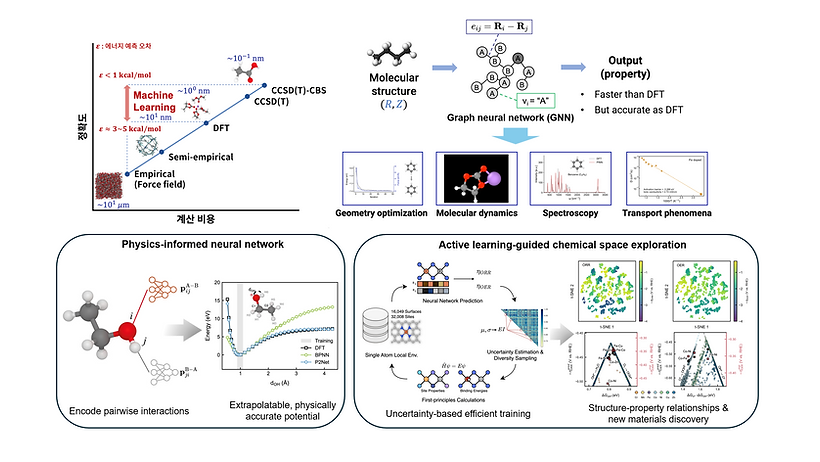
Development of extrapolatable and interpretable machine-learning potentials using physics-informed neural network (PINN) / 물리 기반 신경망(PINN)으로 외삽 가능하고 해석 가능한 머신러닝 포텐셜 개발
-
Efficient exploration of vast material spaces through active learning and high-throughput structure search / 능동학습과 고속 구조 탐색으로 방대한 공간을 효율적으로 탐색
-
Expansion into an autonomous experimentation and physics-based AI catalyst design platform / 자율실험·물리 기반 AI 촉매 설계 플랫폼으로 확장

-
Analysis of atomic-level mechanisms of key electrochemical reactions (HER, OER, ORR) / HER·OER·ORR 핵심 전기화학 반응의 원자 수준 메커니즘 해석
-
Elucidation of the effects of defects, doping, heterojunctions, and surface reconfiguration on catalyst activity and stability / 결함·도핑·이종접합·표면 재구성이 촉매 활성과 안정성에 미치는 영향 규명
-
Derivation of catalyst design principles through first-principles-based high-throughput screening / 제일원리 계산 기반 고속 스크리닝으로 촉매 설계 원리 도출

-
Elucidation of the moisture degradation mechanism in sulfide-based solid electrolytes and proposal of design principles for stabilization / 황화물계 고체전해질의 수분 열화 메커니즘 규명 및 안정화 설계 원리 제시
-
Research on nanoparticle growth kinetics and structural control of porous membranes / 나노입자 성장 동역학과 다공성 분리막의 구조 제어 연구
-
Integrated computational research linking energy storage, electrochemical conversion, separation processes and nanomaterials / 에너지 저장·전기화학 변환·분리공정·나노소재를 잇는 통합 계산 연구